
Termination Letter Format India: Free Template & Notice Rules (2026)
A termination letter is the document an employer issues to end an employment relationship — it states the reason, the effective date, and the settlement terms, and it's the record that matters most if the termination is ever challenged. It is not the same as a relieving letter, which comes later and simply confirms the employee has been formally released from duty. Companies that manage exits over email threads routinely lose track of which letter was sent, when notice started, and whether full and final settlement was actually completed — document management software keeps every exit document filed against the employee's record instead.
Termination Letter vs Relieving Letter vs Resignation Acceptance Letter
These three documents get mixed up because they all show up near the end of employment, but each has a different trigger and a different job:
| Aspect | Termination Letter | Relieving Letter | Resignation Acceptance Letter |
|---|---|---|---|
| Who initiates it | Employer, ending the relationship | Employer, confirming a completed exit | Employer, acknowledging the employee's resignation |
| When issued | At the start of the exit process, stating the reason | After handover and dues are settled | Shortly after the employee resigns |
| States a reason | Yes — misconduct, performance, redundancy, etc. | No — stays neutral, just confirms release | No — just confirms the notice period and last day |
| Legally required | Yes for workman retrenchment (Section 25F); otherwise standard practice | No specific law, but standard practice | No specific law, but standard practice |
Notice Period Rules: What Actually Applies
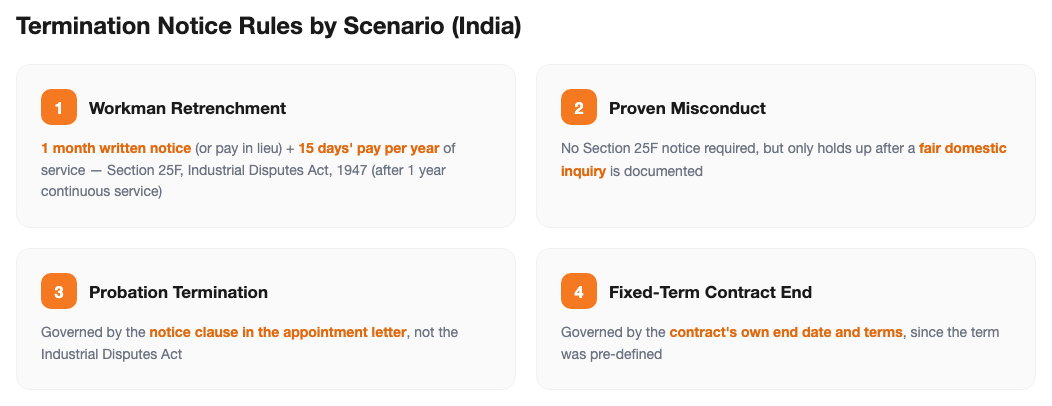
India doesn't have one blanket termination-notice rule — what applies depends on why the employment is ending and how the employee is classified:
- Retrenchment of a "workman": Section 25F of the Industrial Disputes Act, 1947 requires one month's written notice (or wages in lieu) plus retrenchment compensation equal to 15 days' average pay for every completed year of service, once the employee has completed one year of continuous service.
- Termination for proven misconduct: Doesn't require the Section 25F notice or compensation, but only holds up if it followed a fair domestic inquiry — skipping that step is one of the most common grounds a dismissal gets challenged on.
- Probation termination: Usually governed by the notice period stated in the appointment letter itself rather than the Industrial Disputes Act — check that document, not a general rule.
- Fixed-term contract non-renewal: Typically governed by the contract's own terms rather than a statutory notice requirement, since the contract has a defined end date.
- Non-workman staff (most managerial and supervisory roles): Governed by the state's Shops and Establishments Act and the employment contract, which vary by state — check the specific state Act rather than assuming a national default.
Key Components of a Termination Letter
A termination letter needs to be factual and specific enough to withstand scrutiny later. Include:
- Company Letterhead — Official name, logo, and registered address
- Date of Issue — When the letter is being issued
- Employee's Full Name & Designation — As per company records
- Reason for Termination — Stated factually — misconduct, performance, redundancy, or contract expiry
- Effective Date / Last Working Day — The specific date employment ends
- Notice Period or Pay in Lieu — Whether notice was served, waived, or paid out, and how much
- Full & Final Settlement Details — Final salary, leave encashment, gratuity where applicable, and any deductions
- Asset Return Instructions — Laptop, ID card, access cards, and any other company property to be handed back
- Authorized Signatory — HR head or manager's name, designation, and signature, with company seal
Sample Termination Letter Template
[Company Address] | [Phone] | [Email]
Date: [Date]
To: [Employee Full Name]
[Employee Address]
Subject: Termination of Employment
Dear [Employee Name],
This letter is to inform you that your employment as [Job Title] in the [Department] at [Company Name] is being terminated, effective [Last Working Day], on account of [Reason for Termination].
Employment Details:
- Date of Joining: [Date]
- Last Working Day: [Date]
- Designation: [Job Title]
- Notice Period: [Served / Waived / Paid in Lieu — Amount]
Your full and final settlement, including any leave encashment and applicable dues, will be processed as per company policy within [Number] days of your last working day. Please hand over all company property — including [Laptop / ID Card / Access Card] — to your reporting manager or HR before your last working day.
Regards,
[HR Manager Name]
[Title]
[Company Name]
Full & Final Settlement: What Gets Included
The termination letter states that a settlement is coming; it isn't the settlement statement itself. F&F typically covers the final month's pro-rated salary, encashment of unused leave (use our leave encashment calculator to estimate the payout), gratuity if the employee has completed the qualifying period (check with our gratuity calculator), and any recoveries for unreturned assets or notice-period shortfall. Most companies settle this within 30-45 days of the last working day, though the exact timeline is set by company policy rather than a single fixed statutory deadline.
Common Mistakes to Avoid
- Vague reason for termination — "Performance issues" without specifics is far weaker if the termination is ever disputed than a documented history of feedback
- Skipping the domestic inquiry for misconduct cases — Even a clear-cut case can be successfully challenged if due process wasn't followed and documented
- No mention of notice or pay in lieu — Leaves it unclear whether the employer met its notice obligation
- Confusing it with a relieving letter — A termination letter states a reason; a relieving letter deliberately stays neutral
- No settlement timeline — Leaving F&F open-ended is one of the most common sources of post-exit disputes
- Applying one national notice rule to everyone — Workman retrenchment, misconduct dismissal, probation exits, and contract endings each follow different rules
Keep Every Exit Documented and On Schedule
SnapHRM's document management files termination letters, notices, and settlement records against the employee's profile, while asset management tracks laptops, ID cards, and other company property through the return process so nothing gets missed on exit. Free for up to 5 employees, with a self-hosted SnapHRM Pro option for teams that want employee records on their own servers.
Try SnapHRM FreeRelated Articles
Salary Slip Format in India: Components, Free Template & How to Generate Payslips Payroll · 8 min read Leave Policy in India 2026: Types of Leave, Rules & Free Policy Template Compliance · 10 min read Offer Letter Format in India: Free Templates & Complete Guide (2026) Recruitment · 7 min read Employee Onboarding Checklist for Indian Companies: Step-by-Step Guide (2026) HR Management · 9 min read Employee Self-Service Portal: Benefits, Cost & ROI for Small Businesses (2026) HR Management · 9 min read Applicant Tracking System (ATS): Cost, Benefits & ROI for Small Businesses (2026) Recruitment · 8 min read Biometric vs Software-Based Attendance Tracking: Which Is Better for Small Business? (2026) HR Management · 8 min read Expense Management Software: Cost & ROI for Small Businesses (2026) HR Management · 8 min read HR Analytics Software: Cost & ROI for Small Businesses (2026) HR Management · 8 min read Asset Management Software: Cost & ROI for Small Businesses (2026) HR Management · 8 min read Leave Management Software: Cost & ROI for Small Businesses (2026) HR Management · 8 min read Document Management Platforms: Cost & ROI for Small Business (2026) HR Management · 8 min read Best Payroll Software in India 2026: Top 8 Tools Compared Payroll · 15 min read Mandatory HR Policies in India 2026: Labour Code Amendments Compliance · 12 min read Best HR Software for US Businesses in 2026: Top 8 Compared HR Software · 12 min read US Labor Law Compliance Guide for Small Businesses (2026) Compliance · 15 min read Best HR Software for Singapore Businesses in 2026: Top 8 Compared HR Software · 12 min read Singapore Employment Act Guide for SMBs: Complete Overview (2026) Compliance · 14 min read Attendance Management Software: Cost & ROI for Small Businesses (2026) HR Management · 8 min read Employee Onboarding Software: Cost & ROI for Small Businesses (2026) HR Management · 8 min read Relieving Letter Format India: Free Templates & Guide (2026) HR Management · 7 min read Appointment Letter Format India: Free Template & Sample (2026) Recruitment · 8 min read Experience Letter Format India: Free Template & Sample (2026) HR Management · 7 min read Salary Certificate Format India: Free Template & Sample (2026) Payroll · 7 min read Applicant Tracking System Checklist: How to Choose the Right ATS (2026) Recruitment · 8 min read Confirmation Letter Format India: Free Template & Sample (2026) HR Management · 7 min read Expense Management Software vs. Spreadsheets (2026) HR Management · 8 min read Payroll Software vs Excel: Cost, Compliance & Errors (2026) Payroll · 8 min readFree HR Tools
Frequently Asked Questions
Is a termination letter legally mandatory in India?
What is the difference between a termination letter and a relieving letter?
How much notice must an employer give before terminating an employee in India?
Can an employee be terminated without any notice in India?
Manage the Full Employee Lifecycle with SnapHRM
From offer letters at joining to termination and exit records — keep every employee document in one place. Free for teams up to 5 employees.