
An increment letter is the formal document that turns an appraisal decision into a recorded, contractual pay change — the revised CTC, the breakup, and the effective date, in writing. Companies still running payroll off a master spreadsheet often skip this step or send it late, because updating one employee's salary structure means re-checking every downstream formula by hand. This guide covers what an increment letter must include, when it should go out, a free sample template, and how it differs from a promotion letter.
When Should an Increment Letter Be Issued?
Most Indian companies run one annual appraisal cycle aligned to the financial year, so letters commonly go out in late March with the revised pay effective 1 April. That's not a legal deadline, just common practice — three other triggers issue a letter outside that cycle: confirmation after probation (if the role carries a pay bump at confirmation), a promotion, or a retention counter-offer made to keep someone who's about to leave. Whichever trigger applies, the letter should follow the decision closely — an increment communicated verbally in an appraisal meeting but not confirmed in writing for weeks is exactly the gap that causes disputes later about what was actually promised.
Key Components of an Increment Letter
An increment letter is short, but every field on it gets checked against the payslip the moment it lands. It should include:
- Company Letterhead — Official name, logo, and registered address
- Date of Issue — When the letter is being issued
- Employee's Full Name, Code & Designation — As per company records
- Appraisal/Review Period — The period this increment is based on, e.g. FY 2025-26
- Current CTC and Revised CTC — Both figures stated in full, not just the difference
- Revised Salary Breakup — How the increase splits across basic pay, HRA, allowances, and any variable component
- Increment Percentage — The percentage increase, calculated on CTC or fixed pay, stated consistently with how the company usually reports it
- Effective Date — The date the revised pay applies from, including whether any arrears are owed for the gap since that date
- Authorized Signatory — HR head or manager's name, designation, and signature
Sample Increment Letter Template
[Company Address] | [Phone] | [Email]
Date: [Date]
To: [Employee Full Name]
[Employee Code] | [Designation]
Subject: Revision in Compensation
Dear [Employee Name],
Based on your performance during the review period [Review Period], we are pleased to inform you that your compensation has been revised as follows, effective [Effective Date]:
- Current CTC: [Amount] per annum
- Revised CTC: [Amount] per annum
- Increment: [Percentage]%
A detailed breakup of your revised salary structure is attached as Annexure A. All other terms and conditions of your employment, as set out in your appointment letter, remain unchanged unless specifically stated above.
We appreciate your contribution and look forward to your continued performance.
Warm regards,
[HR Manager Name]
[Title]
[Company Name]
How to Calculate the Increment Percentage
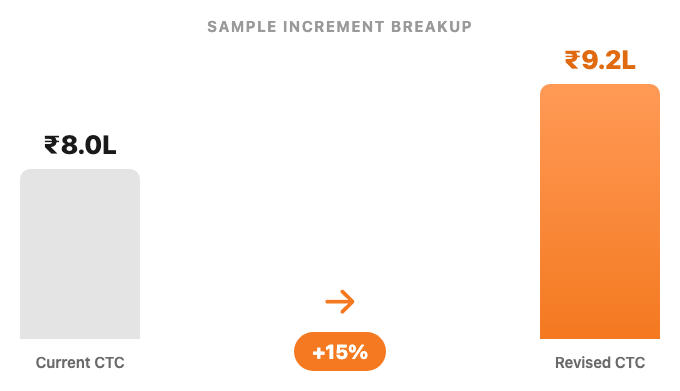
The increment percentage is ((Revised CTC − Current CTC) ÷ Current CTC) × 100. The two numbers that trip people up doing this by hand are deciding whether the percentage is calculated on full CTC or only on fixed pay (state which one explicitly in the letter, since the two give different answers if there's a variable component), and rounding consistently so the stated percentage actually matches the two CTC figures above it. If you'd rather not run the formula by hand, SnapHRM's free salary hike and increment calculator works out the percentage and the revised monthly figure from the old and new CTC in one step.
Increment Letter vs Promotion Letter vs Appointment Letter
All three are compensation-and-role documents, but each records a different event:
| Aspect | Appointment Letter | Increment Letter | Promotion Letter |
|---|---|---|---|
| What changes | Nothing yet — this is the first offer | Pay only, same title and role | Title and role, usually with pay too |
| When issued | On the first day of employment | Annual appraisal cycle, confirmation, or retention offer | When a role or title change is approved |
| Reporting line | Set for the first time | Unchanged | Often changes |
| Mandatory in India | Standard practice, not a specific statute | Standard practice, not a specific statute | Standard practice, not a specific statute |
Common Mistakes to Avoid
- Stating only the new CTC, not the breakup — The employee can't tell whether the increase went into basic pay or a variable component, and the two affect take-home pay differently
- Vague or missing effective date — This is what the percentage, the breakup, and any arrears are calculated from
- Letting a verbal appraisal promise sit unconfirmed for weeks — The written letter is what the employee and HR both rely on if there's ever a dispute about what was agreed
- Not flagging a changed PF or TDS impact — A revised basic pay can change the PF contribution base and move take-home pay less than the stated percentage suggests; raise this before the employee discovers it on the next payslip
- No authorized signatory — Makes the letter harder to verify later for a loan application or background check
Process Increments Without Rebuilding Payroll by Hand
SnapHRM payroll handles salary revisions, increments, and promotions with automatic arrear calculations — update one employee's structure and the next payroll run picks it up, no spreadsheet formulas to re-check. Free for up to 5 employees, with a self-hosted SnapHRM Pro option for teams that want payroll data on their own servers.
Try SnapHRM FreeRelated Articles
Salary Slip Format in India: Components, Free Template & How to Generate Payslips Payroll · 8 min read Leave Policy in India 2026: Types of Leave, Rules & Free Policy Template Compliance · 10 min read Offer Letter Format in India: Free Templates & Complete Guide (2026) Recruitment · 7 min read Employee Onboarding Checklist for Indian Companies: Step-by-Step Guide (2026) HR Management · 9 min read Employee Self-Service Portal: Benefits, Cost & ROI for Small Businesses (2026) HR Management · 9 min read Applicant Tracking System (ATS): Cost, Benefits & ROI for Small Businesses (2026) Recruitment · 8 min read Biometric vs Software-Based Attendance Tracking: Which Is Better for Small Business? (2026) HR Management · 8 min read Expense Management Software: Cost & ROI for Small Businesses (2026) HR Management · 8 min read HR Analytics Software: Cost & ROI for Small Businesses (2026) HR Management · 8 min read HR Analytics Software vs. Excel: Cost, Speed & Accuracy (2026) HR Management · 8 min read Asset Management Software: Cost & ROI for Small Businesses (2026) HR Management · 8 min read Asset Management Software vs. Spreadsheets (2026) HR Management · 8 min read Leave Management Software: Cost & ROI for Small Businesses (2026) HR Management · 8 min read Document Management Platforms: Cost & ROI for Small Business (2026) HR Management · 8 min read Best Payroll Software in India 2026: Top 8 Tools Compared Payroll · 15 min read Mandatory HR Policies in India 2026 With Latest Amendments Compliance · 12 min read Best HR Software for US Businesses in 2026: Top 8 Compared HR Software · 12 min read US Labor Law Compliance Guide for Small Businesses (2026) Compliance · 15 min read Best HR Software for Singapore Businesses in 2026: Top 8 Compared HR Software · 12 min read Singapore Employment Act Guide for SMBs: Complete Overview (2026) Compliance · 14 min read Attendance Management Software: Cost & ROI for Small Businesses (2026) HR Management · 8 min read Employee Onboarding Software: Cost & ROI for Small Businesses (2026) HR Management · 8 min read Relieving Letter Format India: Free Templates & Guide (2026) HR Management · 7 min read Appointment Letter Format India: Free Template & Sample (2026) Recruitment · 8 min read Experience Letter Format India: Free Template & Sample (2026) HR Management · 7 min read Salary Certificate Format India: Free Template & Sample (2026) Payroll · 7 min read Applicant Tracking System Checklist: How to Choose the Right ATS (2026) Recruitment · 8 min read Confirmation Letter Format India: Free Template & Sample (2026) HR Management · 7 min read Expense Management Software vs. Spreadsheets (2026) HR Management · 8 min read Termination Letter Format India: Free Template & Notice Rules (2026) HR Management · 8 min read Payroll Software vs Excel: Cost, Compliance & Errors (2026) Payroll · 8 min read Leave Management Software vs. Spreadsheets (2026) HR Management · 8 min read Expense Management Software Checklist: How to Choose (2026) HR Management · 8 min read Attendance Management Software Checklist: How to Choose (2026) HR Management · 8 min read Applicant Tracking System vs. Spreadsheets (2026) HR Management · 8 min read Payroll Software Features Checklist: What to Actually Look For (2026) Payroll · 8 min readFree HR Tools
Frequently Asked Questions
Is an increment letter legally mandatory in India?
What is the difference between an increment letter and a promotion letter?
When are increment letters usually issued in India?
Does an increment letter need to show the full revised salary breakup?
Can an increment be backdated with arrears?
Run Appraisal Season Without the Spreadsheet Rebuild
Update a salary structure once — SnapHRM recalculates every future payroll run automatically. Free for teams up to 5 employees.